


What Does a Trust Department Do?
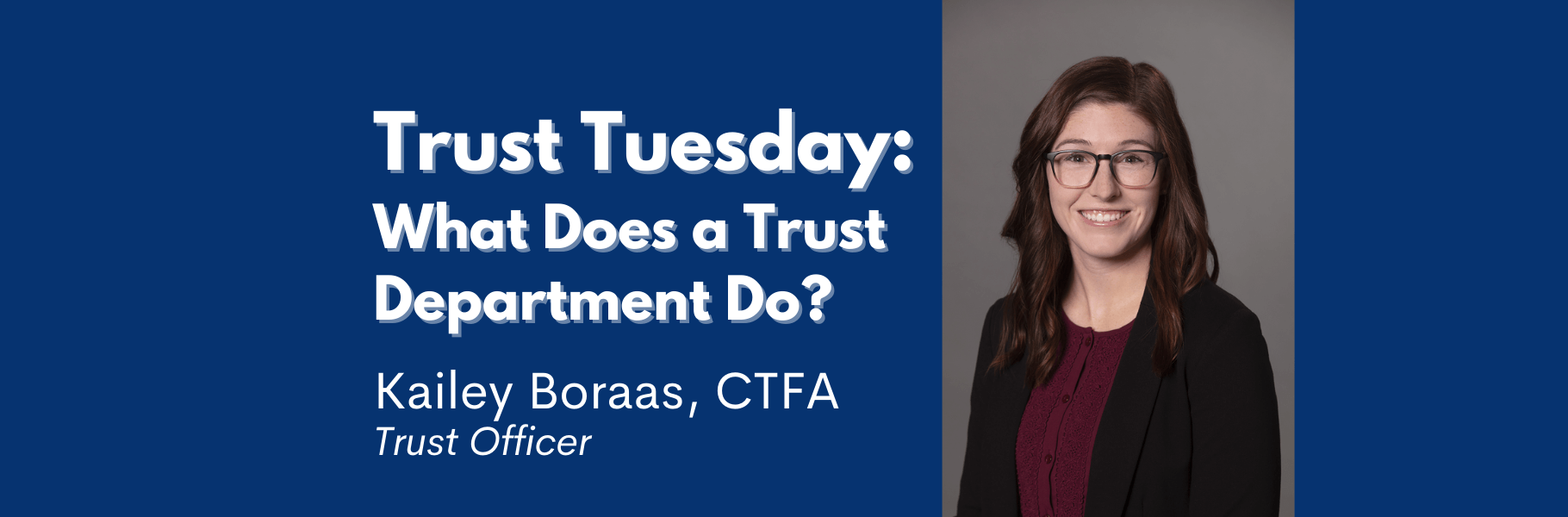
By: Kailey Boraas, CTFA, Trust Officer
Most people find out their bank has a Trust Department the way they find out about a road they have driven past for years. Someone mentions it, and it turns out it has been there the whole time.
Checking accounts, savings accounts, IRAs, wire transfers, loans. Those are the services almost everyone knows. Some banks also have an insurance department. Some have investment advisors. And some have a Trust Department, which handles a different kind of work: money and property that belongs to someone else, managed under rules that someone else wrote.
What does a Trust Department do?
A Trust Department administers Trusts according to their terms and manages the assets held inside them. It may also provide related retirement, investment, custody, and specialized asset-management services.
At First Western, the Trust Department works in these areas:
|
Service |
What it covers |
Who it is for |
|
Personal Trusts and investment management |
Living Trusts, testamentary Trusts, charitable Trusts, mineral Trusts, agency and custody accounts, and portfolio management by our in-house team |
Families planning to transfer assets to the next generation and individuals who want professional investment management |
|
Employer retirement plans |
401(k) and employee benefit plan administration, plan documents kept current with regulations, reporting, and fiduciary investment management |
Businesses that offer a retirement plan, or want to |
|
Individual retirement accounts (IRAs) |
Traditional, Roth, and Rollover IRAs, plus the Trusteed IRA, which can hold stocks, bonds, and mutual funds |
Individuals saving for retirement or consolidating eligible assets from a prior employer plan |
|
Oil and gas mineral management |
Royalty, working, non-operating, and overriding royalty interests; division orders; chain-of-title work; monthly revenue review; K-1 and 1099 preparation; North Dakota withholding for out-of-state beneficiaries |
Mineral owners across the Williston Basin, and anyone who has inherited mineral interests |
|
Farm and land management |
Tenant selection, lease negotiation, rent collection, property inspection, insurance review, and government farm program compliance |
Farmland and ranchland owners, particularly absentee and out-of-state owners |
These descriptions are broad because Trust and retirement services are tailored to each client or employer. First Western administers a range of qualified retirement plans and helps keep plan documents current with applicable regulations.
Investment management may involve an IRA, an agency account, or another portfolio. First Western’s in-house team uses a disciplined, long-term approach tailored to each client’s goals, risk tolerance, and time horizon. The Trust Investment Committee sets investment policy and asset-allocation guidelines and regularly reviews market conditions and portfolio performance.
Learn more about our Trust Department services here:
- 401(k) and retirement plan services
- Investment and asset management
- Personal trust and investment services
- Trusteed IRA
What kinds of Trusts does a Trust Department manage?
More kinds than most people expect. Revocable and irrevocable Trusts. Life insurance Trusts. Charitable Remainder Trusts. Split interest Trusts. Grantor Retained Annuity Trusts and Grantor Retained Income Trusts. Mineral Trusts, which have become common in North Dakota since the Bakken.
If that list sounds like a lot, here is the thing that ties it together. Every Trust has to have property. The document says who benefits, when, and under what conditions, but there has to be something in it. The biggest job a Trust Department does is manage that property, whatever form it takes.
Charitable Trusts show how specific this gets. A Charitable Remainder Annuity Trust pays the annuitant a fixed dollar amount; a Charitable Remainder Unitrust pays a percentage of Trust assets recalculated each year. What remains goes to the charity. Those are different instruments with different tax consequences, and choosing between them is work we do alongside a client’s tax advisor.
Contact First Western’s Trust Department to discuss which Trust or account structure may be appropriate for your goals.
What does a Trust Officer actually do?
A Trust Officer is the person who administers your Trust day to day. They review distribution requests against what the document allows, keep the investments on the stated strategy, handle the tax filings, produce the statements, and answer the beneficiaries’ questions.
In a typical month, a trust officer may review whether a requested distribution is permitted, coordinate information for fiduciary tax returns and K-1s, reconcile account activity, communicate with beneficiaries, and work with the investment team to keep the portfolio aligned with the trust’s objectives.
Some of this work is technical, but clear communication is equally important. Beneficiaries should understand how the trust is being administered and whom to contact with questions.
It is easier to picture through a person than a job description. For more information, read what a Trust Officer is like to work with.
What does it mean for a bank to have Trust powers?
Trust powers are the legal authority a bank needs before it may act in certain fiduciary capacities. The approval process and supervising agencies depend on the bank’s charter and applicable state and federal law. Banks that exercise Trust powers remain subject to regulatory oversight of their fiduciary activities, including account administration, investment practices, controls, and compliance with applicable law.
The consent requirement sits in the FDIC’s rules and regulations, and Trust operations are reviewed under the FDIC’s Trust Examination Manual. The examination looks at whether a bank’s policies and account administration are sound enough that its fiduciary work will not produce losses.
This is rarer than most people assume. Only about one-third of FDIC-insured institutions report holding fiduciary powers. So when a bank has a Trust Department, it has been through a process to get there and stays under review to keep it.
First Western has held full Trust powers since 1972. The Trust Department has been administering Trusts for more than fifty years.
Who uses a Trust Department?
Trust services are sometimes associated only with very wealthy families, but they can be useful in a variety of personal and business situations.
Families may use Trusts to support an aging parent, make a charitable gift, plan for incapacity, provide long-term support for a person with a disability, or transfer farmland and mineral interests under an estate plan. Whether Trust services are appropriate depends on the assets, goals, complexity, and service requirements involved.
Agency accounts and Trusteed IRAs often carry lower thresholds than full Trust administration, which is worth asking about if you are not sure where you would fall. An agency account is the least formal option: it consolidates investment accounts into one portfolio and streamlines recordkeeping and tax reporting, without setting up a Trust at all. It ends at the accountholder’s death, where a living or testamentary Trust can continue.
What happens when a Trust holds minerals or farmland?
The work changes shape. Mineral interests and farmland both need active, specialized management, and they are where a general-purpose approach runs out of road.
Mineral ownership is the clearest case. Royalty income has to be checked against monthly revenue detail. Division orders and chain-of-title questions on inherited minerals have to be resolved. Producer 1099s have to be reconciled against internal records, K-1s prepared, and North Dakota income tax withheld for out-of-state beneficiaries. Surface easements and rights-of-way for well sites and pipelines have to be negotiated. Our staff does this work in house, for clients holding assets in North Dakota, Montana, and Saskatchewan, with relationships across conventional and Bakken and Three Forks producers throughout the Williston Basin. Learn what mineral rights are or more on inheriting mineral and gas mineral rights.
Farmland works the same way. A farm agency relationship covers tenant selection, lease negotiation, rent collection, property inspection, insurance review, and compliance with government agricultural programs. For an absentee or out-of-state owner, that is the difference between owning farmland and running it. Where a client owns both the land and the minerals under it, our farm managers and mineral managers work the file together.
Ask a national Trust department to handle a Williston Basin royalty portfolio and you will get a polite explanation of why they cannot. That is the honest reason to look locally for this kind of work.
How are Trust Department fees structured?
Most Trust Departments charge an annual fee calculated as a percentage of the assets they manage. Some Trusts also carry fixed charges for administration or tax preparation, depending on what the work involves.
When comparing fees, ask for the current schedule and a written explanation of what is included. The size and complexity of the trust, the types of assets involved, and the level of administration required can all affect cost.
For First Western’s current fee schedule and account requirements, call the Trust Department at 701-857-7150.
Deciding whether to use one
Knowing what a Trust Department does is a different question from knowing whether to name one as Trustee of your own Trust. That second question turns on how long the Trust runs, what is in it, and how your family works, and we have written about it separately.
It also tends to come up alongside other estate planning decisions: whether you need a Trust or a Will, how property gets titled, how to keep an inheritance protected.
Talk to someone local
If you want to work through what our Trust Department could do in your situation, our Trust Officers are in Minot, Bismarck, Fargo, and West Fargo, and across our Minnesota and Arizona markets. Call the Trust Department at 701-857-7150 or find your nearest branch.
Investment and Trust products are not deposits, are not FDIC insured, are not insured by any federal government agency, are not guaranteed by the bank, and are subject to investment risk, including possible loss of principal.